
More than 140 EVM-compatible networks can be accessible from one wallet, yet the hardest part of using DeFi is rarely opening a new chain. It is understanding what a transaction will do before signing it. That is the counterintuitive shift behind Rabby: a wallet is no longer merely a place to store keys or press “confirm”. For many users, it is becoming a translation layer between complex smart-contract activity and a human decision.
This matters especially for users in Germany and across the wider German-speaking DeFi community. Ethereum, Arbitrum, Base, Polygon, Optimism, Avalanche and the BNB Chain may all sit in one portfolio, while each network has different fees, applications, bridges and operational risks. A multi-chain wallet can reduce friction, but reducing friction is not automatically the same as increasing safety. The useful question is therefore not whether Rabby is a convenient alternative to MetaMask, but which parts of the transaction process it makes more legible—and where the user must still remain responsible.
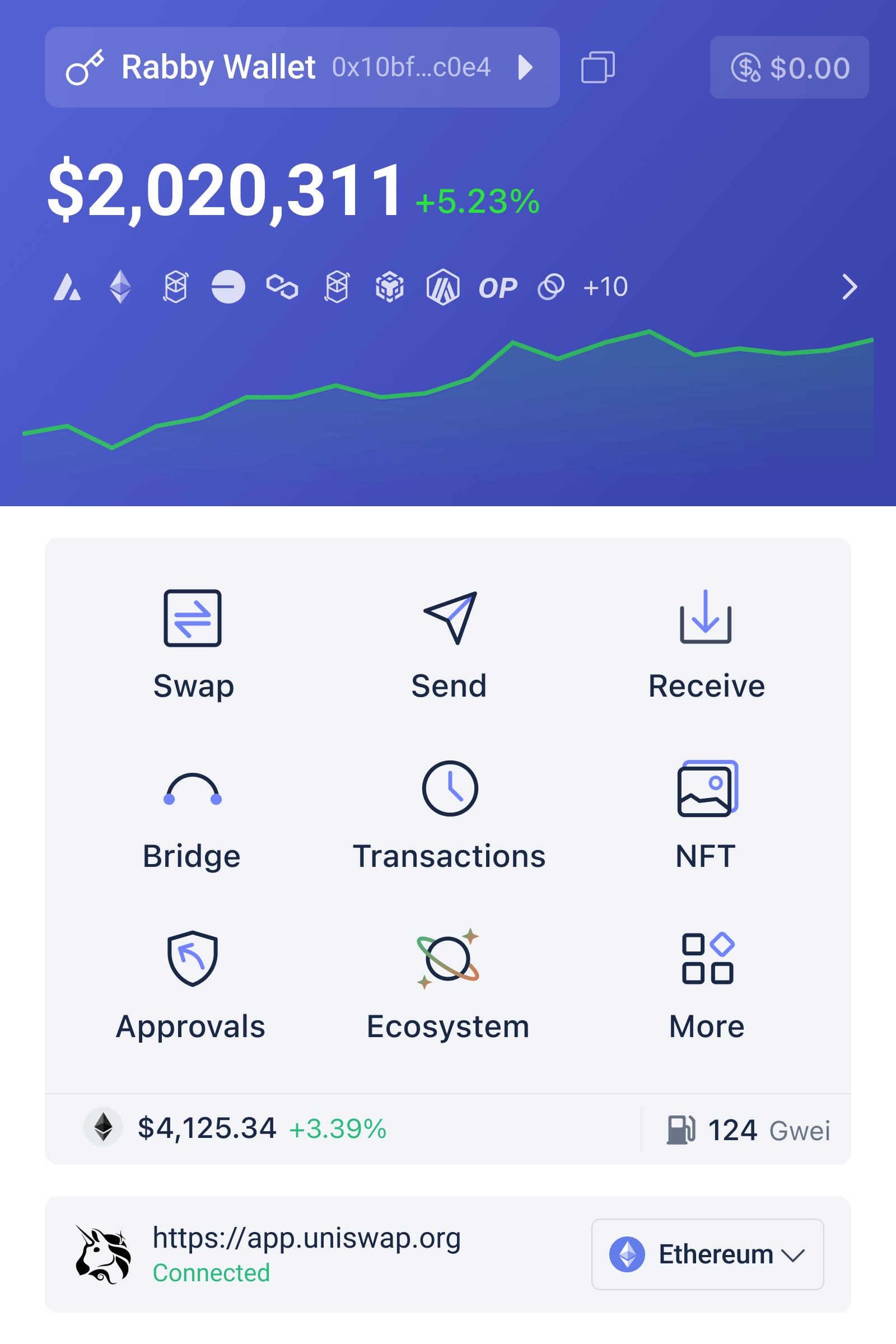
From key storage to transaction interpretation
Early browser wallets established a simple mental model: connect an account, select a network, approve a transaction and sign it. That model becomes strained as DeFi grows more composable. A single action may involve token approvals, a router contract, several liquidity venues, a bridge, and a final asset arriving on another chain. The wallet may display a technical function call, while the economic consequence is what the user actually needs to understand.
Rabby’s central feature is its pre-signing transaction simulation. Before a signature is submitted, the wallet attempts to show the expected changes to token balances and the broader effect of the action. This is important because signing is not the same as sending an ordinary payment. A signature can authorise a contract to move tokens, execute a swap with slippage, or interact with a protocol whose behaviour is not obvious from the dApp interface.
The deeper idea is that simulation changes the wallet from a passive signing surface into a checking layer. It does not prove that a protocol is safe, and it cannot eliminate uncertainty in a changing blockchain environment. It can, however, expose a mismatch between intention and outcome. If a user expects to receive one asset but the simulated result shows an unexpected approval, a different recipient, or a substantial balance reduction, that discrepancy becomes a reason to stop.
Rabby complements simulation with a security engine that checks contracts and addresses for signals associated with phishing, known exploits and unlimited token approvals. These warnings are useful as risk indicators, not as guarantees. Security scanners depend on available data and detection methods; a new or sophisticated malicious contract may not yet be recognised. Conversely, an unfamiliar contract is not automatically fraudulent. The correct interpretation is probabilistic: warnings should raise scrutiny, while the absence of a warning should never replace scrutiny.
Why multi-chain convenience changes the risk equation
Rabby automatically detects the network required by a connected decentralised application and can switch to it. For ordinary users, that removes one of the most persistent sources of operational error: interacting with the right application on the wrong chain. Its broad EVM support also makes it practical to manage assets across major networks without repeatedly importing custom network settings.
Yet automatic network switching introduces a trade-off. Manual network selection is inconvenient, but it can also force the user to notice where an action is taking place. When the interface makes switching invisible, users should deliberately read the chain name and the simulated outcome before signing. Convenience is safest when it removes mechanical work, not when it removes attention.
The same principle applies to integrated swaps and bridges. Rabby can scan decentralised liquidity sources such as Uniswap and 1inch for swap routes, while bridge functionality through providers such as LI.FI can help move assets between chains from inside the wallet interface. This creates a smoother workflow: a user does not necessarily need to visit multiple applications, find a route manually and manage every network change independently.
But aggregation does not abolish market structure. A quoted route still depends on liquidity, price impact, slippage settings, bridge design and the contracts involved. Cross-chain transfers add another layer because assets are not simply travelling through a single shared ledger. They may depend on messaging systems, liquidity providers or representations of value on the destination chain. An integrated interface can simplify discovery; it cannot make every route equally robust.
Gas abstraction is helpful, not magical
One of Rabby’s more practical features is the Gas Account, which can allow users to pay network fees with stablecoins such as USDC across chains even when they do not hold the native token required by that network. This addresses a familiar DeFi failure: an account may contain valuable assets but be unable to move them because it lacks a small amount of ETH, MATIC or another gas token.
Paying gas in a stablecoin improves accessibility because it separates the economic value being moved from the technical token needed to submit the transaction. For a user managing several EVM chains, that can be a meaningful reduction in operational overhead. The boundary condition is that the feature still depends on its supporting infrastructure, eligibility and conversion mechanics. Users should understand the applicable fees and availability rather than assume that every transaction on every network can be paid this way.
This illustrates a broader pattern in wallet design. The best abstractions hide complexity only after the system has handled it correctly. If an abstraction conceals the chain, the route, the fee or the approving contract, it may reduce confidence rather than increase it. The useful wallet is not the one that hides every technical detail; it is the one that surfaces the details that can change the decision.
Custody, code and the remaining human boundary
Rabby is non-custodial: private keys are stored locally on the user’s device rather than transferred to Rabby’s servers. The software is open source under the MIT licence, and it supports hardware wallets including Ledger, Trezor and OneKey. These properties matter because they separate wallet infrastructure from custody. Rabby can help present and review a transaction, but the user—or the connected hardware device—retains control over signing.
That distinction also limits what the wallet can protect. If a seed phrase is exposed, a malicious browser extension is installed, a hardware-wallet prompt is approved without inspection, or a user signs a deceptive message, non-custody does not rescue the account. Open source improves inspectability, but it is not a guarantee that every user can independently audit the code or that every dependency is risk-free.
Rabby’s stated independence from its backend is another useful design feature. It does not itself create or alter transactions, and core signing functions can remain available if Rabby servers experience an outage. Still, some safety information and interface services may rely on external data. A resilient signing path is valuable, but users should distinguish between the ability to sign and the availability of current warnings, simulations or route information.
For higher-value activity, a sensible operating framework has three layers: use a hardware wallet where appropriate, inspect the simulated balance changes, and treat approvals as permissions that may need later review or revocation. This is more durable than relying on a single “safe” label. It also scales from a small test transaction to a larger treasury workflow.
What the current direction suggests
The recent Chrome Web Store description presents Rabby as an open-source browser wallet for Ethereum and EVM networks, designed around a smoother multi-chain DeFi experience and protection features. That positioning reflects where the category is moving. Wallets increasingly compete not only on key management, but on interpretation, routing, fee abstraction and risk communication.
If this direction continues, the important differentiator will be the quality of decision support. Users may eventually judge wallets by how clearly they explain an approval, how reliably they compare expected and actual outcomes, and how they handle uncertainty when a simulation or security signal is incomplete. The open question is whether richer automation will preserve user understanding or create a new kind of complacency.
For readers considering the rabby wallet extension, the practical test is straightforward: connect it first to a low-value account, perform a small transaction, and read the simulation as carefully as the dApp itself. Check the network, recipient, approvals, fee and expected asset changes. Only then should convenience become part of the decision.
Frequently asked questions
Is Rabby safer than a traditional browser wallet?
It offers additional safety-oriented features, including transaction simulation, contract and address warnings, and hardware-wallet compatibility. That can improve decision quality, especially in multi-chain DeFi. It does not guarantee safety, however. Users remain responsible for protecting their keys and checking what they sign.
Can Rabby pay every network fee with USDC?
The Gas Account feature is designed to let users pay eligible fees with stablecoins such as USDC when they lack the native gas token. Availability, supported networks and applicable costs can vary, so users should verify the specific transaction rather than assume universal coverage.
Does transaction simulation replace independent research?
No. Simulation shows the expected effects of a transaction, which is valuable for detecting obvious mismatches and suspicious approvals. It does not establish that a protocol is economically sound, that a bridge is resilient, or that future contract behaviour will be harmless. For unfamiliar or high-value protocols, independent verification remains essential.
The most useful way to think about Rabby is not as a magic shield, but as an additional layer between intention and signature. In a multi-chain environment, that layer matters because complexity creates mistakes even before an attacker appears. A wallet that makes consequences visible can improve security in practice—provided the user treats visibility as an invitation to reason, not permission to stop thinking.